
Le tabagisme affecte-t-il la qualité du sperme ? La science et le chemin de récupération de 90 jours


Saviez-vous que les hommes qui fument ont une concentration de spermatozoïdes inférieure de 13 % à 17 % par rapport à ceux qui ne fument pas ? C’est une statistique alarmante qui conduit souvent à la même question urgente : le tabac affecte-t-il suffisamment la qualité du sperme pour empêcher une grossesse saine ? Si vous vous inquiétez des dommages à l’ADN, des malformations congénitales ou des messages contradictoires autour des cigarettes électroniques aromatisées, vous n’êtes pas seul. Beaucoup d’hommes ressentent le poids de la responsabilité tout en luttant pour rompre une habitude de nicotine de longue date, surtout avec les nouveaux avertissements graphiques de la FDA soulignant des risques comme la dysfonction érectile.
La bonne nouvelle, c’est que votre corps est remarquablement résilient. Nous vous aiderons à comprendre l’impact biologique spécifique du tabac sur l’ADN des spermatozoïdes et pourquoi même de petits changements dans vos habitudes peuvent faire la différence. Vous découvrirez la science derrière le cycle de spermatogenèse de 90 jours et obtiendrez un calendrier réaliste pour la récupération de la santé. Ce guide fournit un plan clair et concret pour protéger votre fertilité et offrir à votre future famille les meilleures chances grâce à un sevrage stratégique et un soutien nutritionnel.
Points clés à retenir
- Découvrez comment les métaux lourds comme le plomb et le cadmium contournent les barrières biologiques naturelles pour créer une « rouille biologique » dans le système reproducteur.
- Apprenez exactement comment le tabac affecte la qualité du sperme en examinant l’impact des toxines sur la motilité des spermatozoïdes et la fragmentation de l’ADN.
- Comprenez pourquoi le vapotage reste un risque pour la fertilité masculine en raison des effets vasoconstricteurs de la nicotine et de la toxicité des agents aromatisants.
- Identifiez les étapes spécifiques du cycle de spermatogenèse de 90 jours pour suivre vos progrès vers une production de spermatozoïdes plus saine.
- Découvrez comment un soutien nutritionnel ciblé avec du zinc et de la L-carnitine peut aider à inverser les dommages oxydatifs et multiplier votre potentiel de fertilité.
Comment les toxines du tabac pénètrent dans le système reproducteur masculin
Lorsque vous inhalez la fumée de cigarette, vous introduisez plus de 7 000 substances chimiques dans votre circulation sanguine. Ce ne sont pas seulement des irritants pulmonaires ; ce sont des toxines systémiques qui se propagent à tous les organes, y compris les testicules. L’une des questions les plus fréquentes chez les hommes qui planifient une famille est : « le tabac affecte-t-il la qualité du sperme ? » La réponse réside dans la façon dont ces substances franchissent les défenses internes de votre corps. Des toxines comme la nicotine, le cadmium et le plomb ne restent pas simplement dans votre sang. Elles infiltrent activement l’environnement délicat où les spermatozoïdes sont produits, modifiant la composition chimique de votre liquide séminal.
Ce liquide sert de milieu de transport protecteur pour vos spermatozoïdes. Pour mieux comprendre les bases de la qualité du sperme, il est utile d’examiner comment des facteurs externes liés au mode de vie, comme la consommation de tabac, peuvent dégrader ces indicateurs vitaux au fil du temps. Pour voir le point de vue d’un spécialiste sur la manière dont ces toxines interagissent avec votre corps, regardez cette vidéo utile :
La barrière hémato-testiculaire et l'exposition chimique
La barrière hémato-testiculaire est un bouclier physique spécialisé conçu pour protéger les spermatozoïdes en développement des substances nocives et des attaques du système immunitaire. C'est l'une des barrières les plus étanches du corps humain. Cependant, certaines toxines présentes dans la fumée de cigarette, en particulier les hydrocarbures aromatiques polycycliques et les métaux lourds comme le cadmium, peuvent franchir cette défense. Une fois qu'elles pénètrent cette barrière, ces toxines s'accumulent dans le tissu testiculaire, créant un réservoir toxique qui perturbe continuellement la production de spermatozoïdes sains.
Stress oxydatif : le tueur silencieux des spermatozoïdes
Pensez au stress oxydatif comme à un moteur fonctionnant avec un carburant sale et contaminé. Dans un corps sain, il existe un équilibre entre les espèces réactives de l'oxygène (ROS) et les antioxydants. Le tabagisme déséquilibre cette balance, inondant le système reproducteur de ROS. Ces molécules instables agissent comme une "rouille biologique", attaquant la membrane externe des spermatozoïdes, riche en acides gras polyinsaturés. Ces dommages à la membrane rendent plus difficile la survie des spermatozoïdes lors du trajet vers l'ovule ou leur pénétration réussie lors de la fécondation. Lorsque les patients demandent : « le tabagisme affecte-t-il la qualité du sperme ? », les médecins pointent souvent ce déséquilibre chimique comme la principale cause de la réduction de la motilité et du nombre.
La nicotine joue également un rôle direct en agissant comme un puissant vasoconstricteur. Elle rétrécit les vaisseaux sanguins dans tout le corps, y compris ceux qui alimentent les organes reproducteurs. Une réduction du flux sanguin signifie que moins de nutriments et d'oxygène atteignent les testicules, essentiels au processus énergivore de production de spermatozoïdes. Lorsqu'on considère l'impact combiné de l'accumulation de métaux lourds, du stress oxydatif et de la restriction du flux sanguin, il devient clair comment le tabagisme dégrade l'environnement biologique nécessaire à une fertilité optimale.
L'impact sur les paramètres du sperme : nombre, motilité et ADN
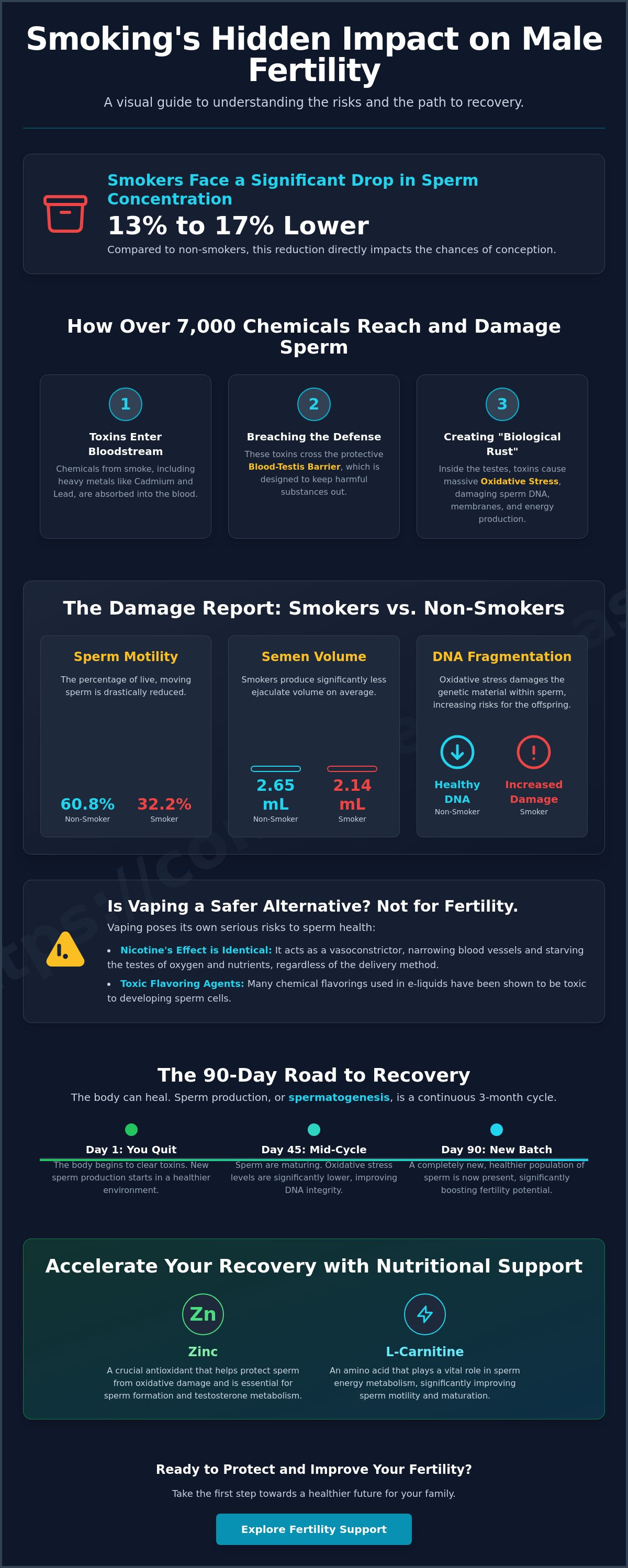
Lorsqu'ils examinent une analyse de sperme, les médecins évaluent plusieurs facteurs clés pour déterminer le potentiel de fertilité d'un homme. Une préoccupation courante chez les couples est la suivante : le tabagisme affecte-t-il suffisamment la qualité du sperme pour retarder la conception ? Les données scientifiques suggèrent que la réponse est un oui retentissant. Une méta-analyse couvrant 26 pays a révélé que les fumeurs avaient systématiquement une concentration de spermatozoïdes inférieure de 13 % à 17 % à celle des non-fumeurs. Il ne s'agit pas seulement de chiffres ; c'est toute l'environnement de l'éjaculat qui est concerné. Une étude de 2025 a souligné que les fumeurs produisaient un volume significativement moindre, en moyenne 2,14 mL contre 2,65 mL chez les non-fumeurs. Ces réductions sont souvent corrélées à la "dose" de tabac, ce qui signifie que ceux qui fument plus de 20 cigarettes par jour constatent les déclins les plus marqués.
Pourquoi le mouvement du sperme (motilité) est important pour la conception
Le sperme doit être de bons nageurs pour atteindre et fertiliser un ovule. Les recherches sur les effets dangereux du tabagisme montrent que les toxines agissent comme des « freins » sur ce mouvement. La nicotine altère spécifiquement la fonction mitochondriale, qui sert de batterie à la cellule spermatique. Sans cette énergie, le sperme a du mal à naviguer dans le tractus reproducteur féminin. Dans une étude menée sur des hommes infertiles, le pourcentage de spermatozoïdes vivants et mobiles a été presque divisé par deux, passant de 60,83 % chez les non-fumeurs à seulement 32,23 % chez les fumeurs. Si ces indicateurs vous préoccupent, explorer des packs de soutien à la fertilité peut être une étape utile pour optimiser votre santé reproductive lors de l'arrêt.
Fragmentation de l'ADN et risque de fausse couche
Peut-être que la conséquence la plus négligée de la consommation de tabac est la fragmentation de l'ADN. Même si un spermatozoïde semble normal au microscope (morphologie) et nage bien (motilité), le matériel génétique à l'intérieur de sa tête peut être fracturé. Ce dommage « caché » est une cause majeure d'échec d'implantation embryonnaire et de perte précoce de grossesse. Pour les hommes de plus de 35 ans, le risque est encore plus élevé car la dégradation naturelle de l'ADN liée à l'âge s'ajoute au stress oxydatif induit par le tabac. En considérant « est-ce que fumer affecte la qualité du sperme », il est essentiel de se rappeler que l'ADN endommagé peut entraîner une fausse couche même si la fécondation a lieu. Arrêter ne vous aide pas seulement à concevoir ; cela contribue à assurer une grossesse saine et à terme.
Vapotage vs. cigarettes : le vapotage est-il plus sûr pour le sperme ?
Beaucoup d'hommes passent aux cigarettes électroniques en pensant avoir trouvé un moyen « plus propre » de consommer de la nicotine sans nuire à leur fertilité. Bien que le vapotage évite la combustion et le goudron présents dans les cigarettes traditionnelles, il est erroné de supposer qu'il s'agit d'un refuge sûr pour la santé reproductive. Lorsque les patients demandent « est-ce que fumer affecte la qualité du sperme », ils se concentrent souvent sur la fumée elle-même. Cependant, la nicotine est le principal responsable de nombreux problèmes de fertilité. Elle agit comme un puissant vasoconstricteur, rétrécissant les vaisseaux sanguins et limitant le flux vital d'oxygène et de nutriments vers les testicules. Cette restriction se produit que la nicotine soit inhalée via une cigarette ou un dispositif de vapotage high-tech.
The regulatory landscape is shifting rapidly. In May 2026, the FDA authorized the sale of four flavored e-cigarette products, a move that has drawn significant scrutiny from public health experts. This authorization doesn't mean these products are "fertility safe." A comprehensive scientific review on smoking and male fertility confirms that nicotine exposure, regardless of the source, contributes to lower sperm counts and impaired motility. If you're looking for more information on lifestyle factors and reproductive health, you can find detailed guides on our fertility blog.
Toxins in E-Liquids Beyond Nicotine
E-liquids contain a cocktail of chemicals that present unique risks. When propylene glycol and vegetable glycerin are heated, they can produce toxic byproducts like formaldehyde and acrolein, both of which are linked to testicular inflammation. Additionally, the metal heating coils in many devices can leach heavy metals like nickel, tin, and lead into the aerosol. Vaping triggers a systemic inflammatory response that increases the presence of white blood cells in seminal fluid, which can further degrade the health of developing sperm. These "less bad" alternatives still introduce significant obstacles to successful conception.
Third-Hand Smoke and Environmental Risks
It's also vital to consider the environment you're creating for your partner. Even if you're vaping or smoking outdoors, third-hand smoke residues can cling to your skin, hair, and clothing. These residues contain toxins that can disrupt your partner's hormonal balance and follicular development. Creating a truly smoke-free home is one of the most effective steps you can take to protect your collective fertility. When you consider how does smoking affect sperm quality, remember that the goal isn't just a better semen analysis; it's a healthy environment for a future pregnancy.
La fenêtre de récupération de 90 jours : que se passe-t-il lorsque vous arrêtez ?
Arrêter de fumer est la méthode la plus efficace pour inverser les dommages causés à votre fertilité. Cependant, beaucoup d'hommes sont surpris d'apprendre qu'ils ne verront pas une amélioration immédiate dans les résultats de leur analyse de sperme. Ce délai est dû au cycle de spermatogenèse, le processus biologique de création de nouveaux spermatozoïdes, qui dure environ 74 à 90 jours. Lorsque vous vous demandez « le tabagisme affecte-t-il la qualité du sperme », vous examinez en réalité un bilan biologique de 90 jours de vos choix de vie passés.
Dans les 30 premiers jours suivant l'arrêt, votre corps commence à éliminer la nicotine et le monoxyde de carbone résiduels. L'inflammation systémique commence à reculer. Vos vaisseaux sanguins, auparavant contractés par la nicotine, commencent à se dilater. Cela améliore le flux sanguin vers les testicules, garantissant que la prochaine génération de spermatozoïdes reçoit l'oxygène et les nutriments nécessaires à leur bon développement.
Au cours du deuxième mois, les nouveaux spermatozoïdes se développent dans un environnement nettement plus propre. La "rouille biologique" ou stress oxydatif évoqué précédemment commence à diminuer. Comme il y a moins d'espèces réactives de l'oxygène attaquant les cellules en développement, ces spermatozoïdes sont moins susceptibles de souffrir de fragmentation de l'ADN pouvant entraîner une perte précoce de grossesse.
Vers le 90e jour, la première "nouvelle" génération de spermatozoïdes atteint sa maturité et est prête pour l'éjaculation. Ces cellules ont passé tout leur cycle de développement à l'abri de l'influence toxique du tabac.
Le calendrier biologique de la production de spermatozoïdes
Comme il faut près de trois mois pour produire un spermatozoïde mature, les choix que vous faites aujourd'hui déterminent votre fertilité dans trois mois. Il est utile d'utiliser un calculateur d'ovulation pour aligner la fenêtre fertile de votre partenaire avec l'arrivée de cette nouvelle génération de spermatozoïdes sains. Suivre vos progrès pendant cette période peut vous motiver alors que votre corps réinitialise son horloge reproductive. Savoir comment le tabagisme affecte la qualité du sperme selon un calendrier aussi précis vous permet de planifier vos tentatives de conception avec beaucoup plus de précision.
Les bénéfices immédiats de l'arrêt du tabac
Bien que la qualité du sperme mette du temps à se rétablir, d'autres bénéfices apparaissent beaucoup plus rapidement. De nombreux hommes rapportent une amélioration de la fonction érectile et une libido accrue en seulement quelques jours après l'arrêt, grâce à une meilleure circulation sanguine. Vos niveaux sanguins de vitamines C et E augmentent également rapidement, offrant une protection antioxydante naturelle. Pour en savoir plus sur l'optimisation de cette transition, consultez notre blog pour plus de conseils sur la préparation de votre corps à la paternité. Si vous êtes prêt à passer à l'étape suivante, vous pouvez explorer nos options de soutien à la fertilité pour vous accompagner durant votre période de récupération de 90 jours.
Optimiser la fertilité masculine : au-delà de l'arrêt du tabac
Éliminer la source des toxines est l'obstacle le plus critique. Une fois que vous avez arrêté d'inhaler la fumée de cigarette ou la vapeur, votre attention doit se porter sur la réparation active. Bien que nous ayons déjà exploré comment le tabagisme affecte la qualité du sperme par le stress oxydatif, la phase de récupération est votre opportunité d'inonder votre système des nutriments nécessaires pour produire une "nouvelle" génération de spermatozoïdes sains. Arrêter crée un environnement propice à la santé, mais une nutrition ciblée fournit les matières premières dont votre corps a besoin pour prospérer.
Les hommes qui ont fumé pendant des années ont souvent des niveaux épuisés d'antioxydants clés. Parce que votre corps a combattu les métaux lourds et les espèces réactives de l'oxygène pendant si longtemps, vous avez probablement besoin de doses plus élevées de certains minéraux pour revenir à la normale. Le zinc et le sélénium sont essentiels pour le bon développement des spermatozoïdes et la protection du matériel génétique dans chaque cellule. La L-Carnitine est un autre atout majeur ; elle fournit l'énergie nécessaire aux spermatozoïdes pour leur motilité, les aidant à nager plus efficacement une fois qu'ils ont atteint la maturité.
Soutien nutritionnel pour la récupération des fumeurs
Ne négligez pas l'importance du CoQ10. Cette enzyme agit comme une source d'énergie pour les mitochondries dans la partie médiane du spermatozoïde. Pensez-y comme une mise à niveau de la batterie pour vos cellules. Pour simplifier ce processus, de nombreux hommes choisissent d'utiliser des packs de soutien à la fertilité qui combinent ces nutriments essentiels dans une routine quotidienne. Cela garantit que votre corps dispose d'un apport constant en antioxydants pour neutraliser les toxines persistantes pendant votre réinitialisation de 90 jours. Lorsque vous réfléchissez à l'impact du tabac sur la qualité du sperme, rappelez-vous que votre objectif est de remplacer un environnement toxique par un environnement riche en nutriments.
La nutrition n'est qu'une pièce du puzzle. Vos habitudes quotidiennes agissent comme des multiplicateurs pour votre santé reproductive. Un sommeil de qualité est indispensable car la production de testostérone atteint son pic pendant le repos. Visez sept à huit heures de sommeil ininterrompu pour soutenir l'équilibre hormonal. L'exercice modéré joue également un rôle en améliorant la circulation systémique, ce qui aide à acheminer ces nouveaux nutriments vers les testicules. Évitez les environnements à haute température comme les saunas ou les bains à remous pendant cette période, car une chaleur excessive peut annuler les progrès réalisés en endommageant les spermatozoïdes en développement.
Surveiller le succès et rester motivé
Le chemin vers la paternité est autant psychologique que physique. Il est souvent utile de lire les avis d'autres hommes qui ont emprunté ce même parcours. Voir des histoires de réussite réelles peut fournir la motivation nécessaire pour rester sans tabac pendant la fenêtre de spermatogenèse de 90 jours. Cette période de planification « pré-conception » est un moyen puissant pour les futurs pères de prendre en main leur santé. Si vous avez maintenu un mode de vie sain pendant six mois et que vous n'avez toujours pas obtenu de grossesse, il est conseillé de consulter un spécialiste de la fertilité. Il pourra réaliser une analyse détaillée du sperme pour s'assurer qu'il n'y a pas de problèmes sous-jacents au-delà de l'impact historique du tabac. Commencez votre parcours de 90 jours dès aujourd'hui et offrez à votre futur enfant le meilleur départ possible.
Prenez le contrôle de votre réinitialisation de fertilité de 90 jours
Faire le premier pas vers une vie sans tabac est une décision puissante pour votre future famille. Nous avons vu comment des toxines comme la nicotine et les métaux lourds infiltrent le système reproducteur, provoquant stress oxydatif et fragmentation de l’ADN. Cependant, le cycle de spermatogenèse de 90 jours offre une fenêtre biologique claire pour la récupération. En éliminant ces substances nocives et en fournissant à votre corps des antioxydants ciblés, vous pouvez améliorer significativement la santé de votre prochaine génération de spermatozoïdes.
Bien que la question le tabagisme affecte-t-il la qualité du sperme ait une réponse scientifique claire, votre attention doit désormais se porter sur l’avenir. Vous n’êtes pas obligé de traverser cette transition seul. Vous pouvez commencer votre parcours de fertilité de 90 jours avec nos packs spécialisés pour la fertilité masculine. Ces compléments sont formulés scientifiquement pour la motilité des spermatozoïdes et sont approuvés par des couples dans plus de 70 pays. Vous pouvez même lire des avis réels d’autres futurs papas qui ont réussi à améliorer leur santé reproductive. Chaque jour sans tabac vous rapproche d’une conception saine. Votre engagement aujourd’hui est la base de l’avenir de votre enfant.
Questions fréquemment posées
Combien de temps faut-il pour que le sperme s’améliore après avoir arrêté de fumer ?
Il faut environ 90 jours pour observer des améliorations significatives de la qualité du sperme après avoir arrêté de fumer. Cette période correspond au cycle biologique de la spermatogenèse, durant lequel les nouveaux spermatozoïdes mettent environ 74 à 90 jours pour se développer complètement. Bien que votre corps commence à guérir de l’inflammation en quelques semaines, la première génération de spermatozoïdes non exposés aux toxines du tabac n’atteint la maturité qu’après trois mois complets.
Fumer une ou deux cigarettes par jour peut-il affecter ma fertilité ?
Oui, même fumer une ou deux cigarettes par jour peut avoir un impact négatif sur votre santé reproductive. Les recherches montrent que les dommages au sperme dépendent de la dose, mais il n’existe aucun niveau d’utilisation du tabac sans risque. Même les fumeurs légers présentent des niveaux plus élevés de stress oxydatif et de fragmentation de l’ADN par rapport aux non-fumeurs. Ces facteurs peuvent rendre plus difficile la fécondation de l’ovule par le sperme ou le maintien d’une grossesse saine.
La marijuana affecte-t-elle la qualité du sperme de la même manière que le tabac ?
La marijuana affecte la qualité du sperme en perturbant le système endocannabinoïde, qui est essentiel au développement et au mouvement des spermatozoïdes. Comme le tabac, elle peut entraîner une diminution du nombre de spermatozoïdes et une morphologie anormale. Des études indiquent que le THC peut spécifiquement altérer la réaction acrosomale, c’est-à-dire la capacité du spermatozoïde à pénétrer la couche externe de l’ovule. Cela constitue un obstacle important pour les couples qui essaient de concevoir naturellement.
Est-il possible d’avoir un bébé en bonne santé si le père fume ?
Il est certainement possible d’avoir un bébé en bonne santé si le père fume, mais les risques statistiques de complications sont plus élevés. Le tabagisme augmente la probabilité de dommages à l’ADN dans les spermatozoïdes, ce qui est lié à une incidence plus élevée de fausses couches et de certaines malformations congénitales. Arrêter avant la conception réduit significativement ces risques et offre un environnement plus sain pour votre partenaire et le fœtus en développement pendant la grossesse.
Arrêter de fumer augmentera-t-il immédiatement mon nombre de spermatozoïdes ?
Arrêter de fumer n'augmentera pas immédiatement votre nombre de spermatozoïdes car votre corps a besoin de temps pour éliminer les toxines et relancer une production saine. Vous pourriez remarquer une meilleure énergie et libido en quelques jours, mais le nombre et la concentration réels de vos spermatozoïdes ne montreront pas de changements mesurables avant environ trois mois. La patience est essentielle pendant que votre système reproducteur se réinitialise et commence à produire des cellules dans un environnement sans toxines après le sevrage initial.
La gomme à la nicotine ou les patchs nuisent-ils aussi au sperme ?
Les thérapies de remplacement de la nicotine comme les gommes ou les patchs sont meilleures que le tabac car elles ne contiennent pas de goudron ni de métaux lourds, mais la nicotine elle-même affecte toujours la fertilité. La nicotine est un vasoconstricteur qui réduit le flux sanguin vers les testicules et peut altérer la barrière hémato-testiculaire. Bien que ces outils soient utiles pour arrêter de fumer, l'objectif pour une fertilité optimale doit être de devenir complètement exempt de nicotine afin d'assurer les meilleurs résultats reproductifs.
L'exposition de mon partenaire à la fumée secondaire peut-elle affecter nos chances de concevoir ?
Oui, la fumée secondaire réduit considérablement vos chances de concevoir en affectant les deux partenaires. Pour la personne qui inhale la fumée, cela peut perturber l'équilibre hormonal et endommager la qualité des ovules. Pour le fumeur, la question le tabagisme affecte-t-il la qualité du sperme s'étend à l'environnement qu'il crée. Les toxines sur les vêtements et la peau peuvent encore atteindre le partenaire, compliquant davantage le chemin vers une grossesse réussie et saine.
Quels sont les meilleurs compléments à prendre après avoir arrêté de fumer pour aider les spermatozoïdes ?
Les meilleurs compléments pour soutenir la récupération incluent des doses élevées d'antioxydants comme le zinc, le sélénium et la vitamine C pour neutraliser le stress oxydatif persistant. La L-carnitine est également bénéfique pour améliorer la motilité des spermatozoïdes, tandis que le CoQ10 fournit l'énergie cellulaire nécessaire à un développement sain. Ces nutriments aident à réparer les dommages causés par des années de tabagisme et fournissent les éléments essentiels pour le parcours de récupération de 90 jours vers la paternité.


